
Leave Your Message

Why Choose an Activated Carbon Adsorption Box?

An Activated Carbon Adsorption Box can help control odors and capture certain airborne pollutants in industrial exhaust. Inside the unit, air passes across a carbon bed. Molecules cling to the carbon’s porous surface. The equipment looks simple. Its performance is not. Flow rate, humidity, contaminant type, and carbon-bed depth all affect results.

Industry data shows why this technology receives attention. Grand View Research’s Activated Carbon Market Size, Share & Trends Analysis Report estimated the global market at USD 4.73 billion in 2023 and projected 9.3% annual growth from 2024 to 2030. That figure covers activated carbon broadly, not adsorption boxes alone. It is useful context, but not proof that one unit fits every plant. Harry Marsh and Francisco Rodríguez-Reinoso, authors of the technical reference Activated Carbon, emphasize a key principle: adsorption performance depends on carbon pore structure and operating conditions.

In practice, buyers should check the target compounds, airflow, inlet concentration, and replacement plan before choosing a box. A technician may also need to inspect pressure drop and sample outlet air. Small details matter. A poorly matched carbon grade can exhaust early, even when the housing looks well built. The box may reduce emissions effectively, but it is not a universal fix. Ask for documented performance data under conditions close to your own process. Then review it with a qualified air-treatment professional. Some uncertainty remains; real exhaust streams can change from shift to shift.
Why Choose an Activated Carbon Adsorption Box?

What Is an Activated Carbon Adsorption Box?

Why Choose an Activated Carbon Adsorption Box?

What Is an Activated Carbon Adsorption Box?

An activated carbon adsorption box is an air-treatment unit that holds porous carbon media. Its many tiny pores provide a large surface area where certain gases and vapors can collect. The process is called adsorption: pollutants attach to the carbon’s surface rather than soaking into it.

Not a simple filter. A common example is air carrying solvent odors through a box filled with carbon granules. The carbon can capture some odor-causing compounds, depending on the media and operating conditions. It does not remove every gas, dust particle, or airborne hazard.

A typical box has an inlet, a sealed media chamber, and an outlet. Air must pass through the carbon, not around its edges. Contact time matters; air pushed through too quickly may leave less time for capture. Humidity and competing compounds can also reduce performance.

Carbon gradually becomes spent, even when it still looks clean. That can be easy to miss. Operators may track odor, airflow, and service hours, but smell alone is not a reliable measurement. Correct sizing and regular media replacement matter.

An adsorption box is useful when matched to a known contaminant, yet its limits deserve attention.

How Does the Adsorption Process Work?

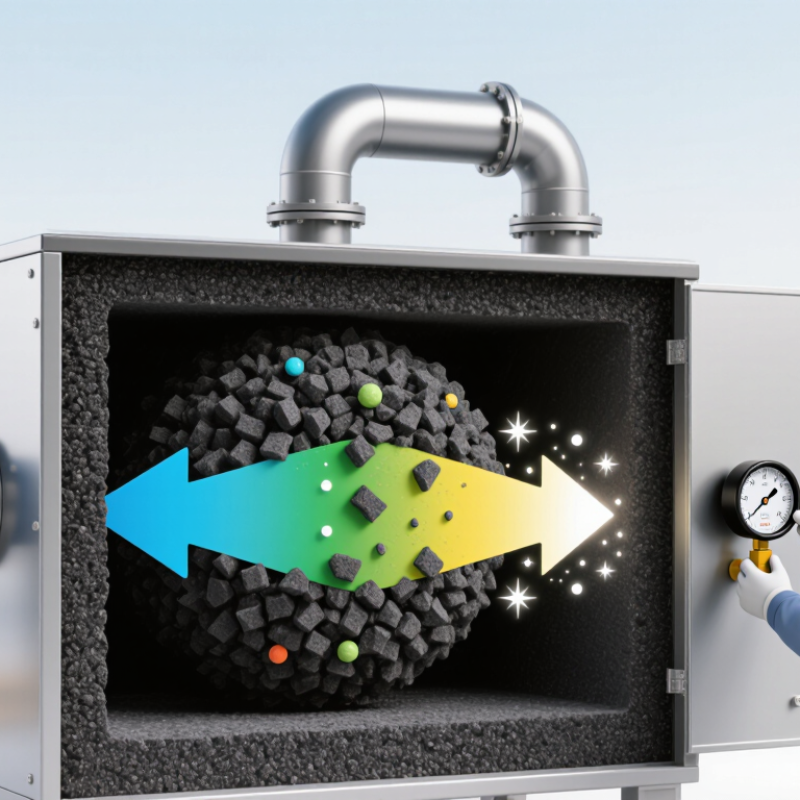
When contaminated air enters an activated carbon adsorption box, it passes through a bed of porous carbon. The material contains many tiny pores, creating a large surface area. Certain gas molecules are attracted to that surface and stay there. This is adsorption, not absorption: the pollutants collect on the carbon rather than soaking into its body. The process is selective. Carbon can capture some odors and volatile organic compounds more readily than others.

Contact time matters. If air moves too quickly, some molecules may pass through before reaching an available pore. A well-sized bed gives the air more time in contact with the carbon. Imagine a steady stream crossing a dark, granular layer. The flow should be even, not concentrated along one edge. Gaps or uneven packing can reduce performance.

The carbon does not hold pollutants forever. Its pores gradually fill, and a change in odor may signal that replacement is due, though smell alone is not a reliable test. Humidity can also affect capture, depending on the pollutant and system conditions. Real installations are rarely perfect. Airflow, moisture, and contaminant levels can vary from hour to hour. Regular inspection and suitable monitoring help reveal when the bed is no longer working as intended.

Which Airborne Pollutants Can It Capture?

An activated carbon adsorption box can reduce certain airborne chemicals by holding their molecules on a porous carbon surface. Common targets include volatile organic compounds (VOCs) released from fresh paint, cleaning products, adhesives, and some furnishings. It may also help capture compounds behind cooking, musty, or smoke odors. Performance depends on the substance and how long air contacts the carbon. Some media are treated for specific gases, but ordinary activated carbon is not a universal gas filter. Not everything, though.

Fine dust, pollen, and droplets need a particle filter; carbon alone does not reliably remove them. It should not be relied on to control carbon monoxide or every hazardous gas. Capture depends on carbon type, bed depth, humidity, airflow, and contact time. A box beside a solvent source may perform differently from one in a large, drafty room. In practice, this is less tidy than a product chart suggests. When the carbon’s adsorption sites fill, performance can decline before an odor becomes noticeable. Check the media specifications and replacement guidance for the pollutants present; a smell test is not a dependable measure of remaining capacity.

Why Choose an Activated Carbon Adsorption Box? — Which Airborne Pollutants Can It Capture?

Pollutant group Examples Typical capture potential Important considerations
Volatile organic compounds (VOCs) Benzene, toluene, xylene, and many solvent vapors Often effective Performance depends on the carbon type, pollutant concentration, airflow, contact time, and humidity. Different VOCs are adsorbed at different rates.
Odorous organic vapors Cooking and process odors, fuel vapors, and some solvent-related smells Often effective Odor removal varies with the odor compounds present. A decrease in odor does not by itself confirm that air is free of harmful pollutants.
Formaldehyde and other reactive gases Formaldehyde and certain aldehydes Media-dependent Standard activated carbon may have limited capacity for some compounds. Specially treated or impregnated media may be needed.
Acid gases Hydrogen sulfide, sulfur dioxide, and hydrogen chloride Specialized media required Ordinary activated carbon may not provide reliable removal. Media designed or impregnated for the target gas is generally required.
Ammonia and amines Ammonia and selected amine vapors Specialized media required Capture depends on the media formulation and operating conditions; standard carbon alone may be unsuitable.
Particles and aerosols Dust, pollen, smoke particles, and liquid mists Not the primary function Use an appropriately rated particle filter, such as a suitable particulate filter, alongside gas-phase treatment when needed.
Carbon monoxide, carbon dioxide, and radon CO, CO₂, and radon gas Not reliably captured An activated carbon adsorption box should not be relied on to control these gases. Use suitable source control, ventilation, monitoring, or purpose-designed treatment.

Selection note: Actual removal performance depends on the target contaminant, carbon or media formulation, bed depth, airflow, contact time, temperature, humidity, and filter condition. Follow the equipment and media supplier’s specifications and replace media when its service life is reached.

What Benefits Does It Offer for Air Treatment?

An activated carbon adsorption box can reduce certain gases and odors as air passes through its porous carbon bed. The material captures molecules on its internal surface, rather than trapping dust like a particle filter. This distinction matters in workshops, kitchens, and other spaces where fumes or persistent smells affect comfort. A properly sized unit can help lower concentrations of selected volatile organic compounds, depending on the carbon type and contact time. It can make a room feel fresher. But it does not remove every contaminant.

Performance depends on airflow, pollutant concentration, humidity, and the amount of carbon inside the box. If air moves too quickly, some molecules may pass through before adsorption occurs. High humidity can also compete for adsorption sites, so real-world results may differ from a simple product claim. Results vary. The carbon eventually becomes saturated. Operators should inspect seals and replace media according to service guidance or measured breakthrough, not odor alone. Some gases have little smell, and odor fatigue can mislead. Not magic, though. For broader air treatment, combine adsorption with suitable particle filtration and source control, then verify performance with relevant monitoring.

Why Choose an Activated Carbon Adsorption Box?

Activated carbon’s porous structure provides a large surface for adsorbing many gaseous pollutants, including some VOCs and odor-causing compounds. The 500–1,500 m²/g range shown is representative; actual surface area varies by carbon type and product. Treatment performance also depends on factors such as humidity, pollutant concentration, and contact time.

How Do You Choose and Maintain the Right Unit?

Choosing and maintaining an activated carbon adsorption box starts with the air, not the cabinet. Identify the contaminants, their approximate concentrations, airflow, and operating temperature. A system designed for one vapor may perform poorly with another. Fit matters.

Compare the required airflow with the unit’s rated capacity, and check the expected pressure drop against your ventilation system. Carbon bed depth and contact time affect performance, so avoid choosing by box size alone. High humidity can reduce adsorption for some contaminants; confirm the operating limits for the specific application. Ask for performance data under conditions close to your own, rather than relying on a broad efficiency claim. Sizing from one average reading can mislead. Check peak conditions too.

After installation, record airflow and pressure drop as a baseline. Inspect seals, access panels, and the carbon bed at scheduled intervals. A rising pressure drop may indicate loading or blockage, while odor alone is not a dependable indicator of breakthrough. Where exposure control matters, use suitable monitoring or sampling to guide replacement. Follow the unit’s maintenance instructions, and handle spent carbon according to applicable site procedures. Keep records. A simple log may feel tedious, but it helps reveal gradual changes that a quick inspection can miss.